Far-right racism and government surveillance have created a hostile environment around the world for followers of humanity’s second-largest religion.
Executive Committee of the Communist International
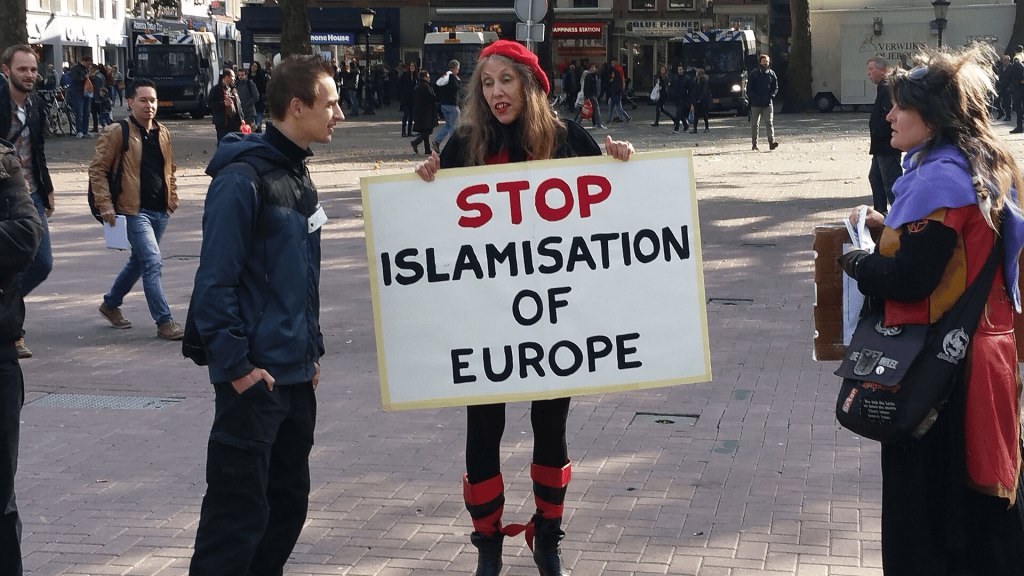
Shortly before noon on May 18, two teenagers drove up to the Islamic Center of San Diego in Clairemont and opened fire. Amin Abdullah, the mosque’s security guard, was outside when they arrived. Police later credited him with preventing a far worse attack. Mansour Kaziha had worked at the center for years. Nader Awad lived across the street. Both men ran toward the parking lot to pull the gunmen away from the building and the children inside it. The gunmen killed all three. A few blocks away, they fired at a landscaper and missed, then shot themselves in their car. According to reporting that relied on unnamed sources, the car contained anti-Islamic writings.
The Council on American-Islamic Relations recorded 8,683 complaints of anti-Muslim discrimination in 2025. It was the highest count since the organization started keeping records in 1996, and the third straight year at that level. The national total rose only 0.3 percent over 2024, so the count has plateaued at a record height.
Officials called the killings reprehensible and asked the country to pray. None of them said where the rhetoric that produced them came from. It came from their own ranks. The men and women who run the U.S. state and the parties competing to run it have spent two decades building a category of dangerous person, and they are now using it against people who live down the road. This is not a byproduct of how they talk about Islam. It is what the talk is for. As the distance between the owners of capital and everyone else widens, it becomes useful to present the world’s second-largest religion, whose adherents are mostly Black and brown, as a threat to a Western civilization that must be defended.
In December 2025, Director of National Intelligence Tulsi Gabbard spoke at the Turning Point USA AmericaFest conference in Phoenix. She told the audience that Muslims in Paterson, New Jersey, and Houston were working to impose Islamic principles through laws or violence. The office she heads was created to fix the intelligence failures exposed on September 11. That same year, Texas Governor Greg Abbott issued a proclamation naming CAIR and the Muslim Brotherhood as foreign terrorist and transnational criminal organizations. Florida Governor Ron DeSantis followed with an executive order barring state agencies from giving contracts, jobs, or funds to CAIR, the Brotherhood, or anyone the state judged to have materially supported them. Under federal law, only the State Department can declare a foreign terrorist organization. The governors made the designations anyway, and CAIR is suing both states.
Florida based its order partly on CAIR’s appearance as an unindicted co-conspirator in the Holy Land Foundation prosecution, a Bush-era terrorism-financing trial held in Dallas. Prosecutors never charged CAIR with anything. Nearly two decades later, a Florida governor reached back to that trial’s list of unindicted names and treated it as evidence.
The instruments these men use are older than their administrations. The material-support statute dates to 1996, and the USA PATRIOT Act expanded it in 2001. The Senate passed the PATRIOT Act 98 to 1. In Britain, Prevent began in 2003 as one strand of the counterterrorism strategy and became a statutory duty on schools, hospitals, and councils in 2015. It has produced an atmosphere of suspicion in classrooms and clinics that falls on Muslims more than anyone else. Liberal and social-democratic governments wrote most of these instruments and renewed them in office, in the name of an emergency they said would pass. The occupation of Afghanistan ended in 2021. The statutes and duties remain, and they now belong to a political current that does not bother to distinguish Islam from Islamism.
The attacks of the early 2000s did not create Islamophobia, and the jihadist attacks that followed in Europe and North America never approached the scale of the apparatus built in response. That apparatus expanded regardless, through years in which the groups it was designed to fight were mostly consumed by the power vacuums that U.S. foreign policy opened in Iraq, Libya, and Syria. Western hostility to Muslims runs back much further than 2001, to the colonial administration of Muslim populations in Algeria and elsewhere. What has changed is that the security state’s machinery now serves an openly racist politics rather than a national-security argument, and it works alongside a campaign fought in the name of white Christian identity.
At a Cabinet meeting in early December 2025, the President called Minnesota’s Somali community “garbage.” Weeks earlier, a right-wing outlet had published unsubstantiated claims that Somali Minnesotans were funding terrorism with money stolen from public programs. The Department of Homeland Security began Operation Metro Surge on December 1 and called it the largest immigration enforcement operation in its history. By the time the administration ended it in February, federal agents had made about 4,000 arrests. Officers had also shot and killed two U.S. citizens in Minneapolis, Renée Good and Alex Pretti.
According to federal data, 58 percent of the roughly 107,000 people of Somali descent in Minnesota were born in the United States. Most of the rest are naturalized citizens or legal residents. Somalis were not even the largest group among those arrested. Nearly a quarter of the complaints CAIR’s Minnesota office received in all of 2025 came in December.
Those families are in Minnesota because employers wanted their labor. In 2018, East Africans made up about 60 percent of Amazon’s workforce in the Twin Cities area. At the Shakopee fulfillment center, the quota was 230 items an hour, and a worker who left the line to pray fell behind it. That December, Somali workers marched outside the warehouse chanting “hear our voice.” They walked off the job again the following March, and again on Prime Day in July 2019. A warehouse where federal agents are expected in the neighborhood does not organize. The President’s language serves Amazon whether or not anyone at Amazon asked for it.
In Britain, the same fusion happened on the street rather than through an agency. On July 29, 2024, a seventeen-year-old attacked a children’s dance class in Southport and killed three girls. Within hours, posts on X claimed the attacker was a Muslim asylum seeker and gave him an invented Arabic name. He was born in Cardiff. Between July 29 and August 9, false claims about his identity drew 155 million impressions on X, and anti-Muslim content on the platform drew 80 million. A crowd attacked the Southport mosque. Other crowds set fire to hotels housing asylum seekers. The rioters did not distinguish between the mosque and the asylum hotel, because the posts that sent them out had already merged the two. Police in England and Wales recorded 4,478 hate crimes against Muslims in the year ending March 2025, and the Home Office tied that August’s spike to the murders and the disorder.
The anti-Muslim right of 2026 treats the terrorist and the invader as one figure. Researchers at Equality Labs have documented the merger in online rhetoric, where new invasion narratives run together with the counterterrorism narratives of the years after September 11. In this version, migrants are not people looking for work and safety but an organized movement to replace white Christians in Europe and North America.
A second narrative casts Muslim men as sexual predators. In Britain, the vehicle is the phrase “grooming gangs,” applied to rings run by men of South Asian heritage who recruited and abused children. In January 2025, after pressure from Elon Musk and the far right, Keir Starmer commissioned an audit from Baroness Louise Casey, and in June he announced a national inquiry. That inquiry opened in April 2026 under Baroness Anne Longfield and has not yet reported. Casey’s audit has found that police had failed to record perpetrator ethnicity in two-thirds of cases nationally, and that in Greater Manchester, West Yorkshire, and South Yorkshire, where records were adequate, suspects were disproportionately men of Asian heritage. She also wrote that the common claim that most such offenders are white was at best misleading. Liberal commentators had leaned on that claim for a decade, and so had parts of the left.
Casey also described what happened to the girls. Police and social workers often treated them as adults who had chosen their situation, and in some cases the state prosecuted them. Casey recommended reviewing and quashing those convictions. Two failures produced the whole catastrophe. The first was a local political settlement that treated South Asian neighborhoods as blocs to be managed through intermediaries and otherwise left alone. The second was the contempt of the state’s own officers for girls who were poor and often in council care. Liberal councils tolerated the first in the name of community relations. The far right says nothing about the second, because naming it would mean indicting the councils, police forces, and children’s services that failed working-class children, whoever the perpetrators were. The far right did not take up these girls until the perpetrators could be used to put Islam itself on trial.
There is also a culinary front. In April 2023, India’s Directorate General of Foreign Trade ruled that meat could be exported as halal-certified only from facilities certified under the Quality Council of India’s scheme by an accredited body. India’s buffalo-meat industry sells to the Gulf and Southeast Asia, and those buyers require the certificate. New Delhi made sure its exporters could produce one. Seven months later, on November 18, 2023, the Uttar Pradesh government of Yogi Adityanath banned the manufacture, storage, sale, and distribution of halal-certified food inside the state. Goods made for export were exempted. A Muslim trader selling certified food to Muslim customers in Lucknow became part of a criminal conspiracy. A meatpacker in the same state shipping certified meat to Jeddah did not.
A halal certificate is an ordinary instrument of commerce. A certifying body inspects a supply chain, charges a fee, and licenses a mark that buyers in a given market want to see. Kosher, organic, and fair-trade labels work the same way. Firms certify cement and bottled water because a distributor in Dubai or Jakarta will pay more for the certified product. The conspiracy theory turns that fee into a secret tax on non-Muslims and a hidden subsidy for mosques or terrorism. The ban has hit the Muslim-owned certifier and the small vendor selling to his own neighborhood. Exporters kept their certificates and their Gulf contracts.
A Muslim woman is not free to play sports without the state’s involvement either. France bars public employees from wearing religious symbols at work, and Quebec’s Bill 21 does the same for teachers and others in positions of authority. A Catholic teacher can leave a crucifix at home. For many Muslim women, the headscarf is not an ornament, so a rule written for all faiths lands on them. In February 2025, the French Senate voted 210 to 81 to extend the same principle to competitions run by sports federations. The National Assembly has not passed it, and both Macron’s party and Le Pen’s have filed their own versions.
Britain has no such law, and employers and the public produce a similar result without one. Using Labour Force Survey data from 2002 to 2013, the Bristol sociologist Nabil Khattab found that Muslim women were 71 percent more likely than white Christian women to be unemployed, holding education, language, marital status, children, and strength of religious belief equal. In November 2025, the Muslim Census surveyed more than 1,100 Muslims about public transport. Forty-five percent of Muslim women said they felt unsafe on buses and trains, compared with 8 percent of women nationally. Sixty-nine percent had changed how they travel, some by changing what they wear.
The Commons Women and Equalities Committee reported in February 2026 that Muslim women also face pressure from inside their own communities, from patriarchal networks that challenge women seeking independence and from abusers who invoke custom to justify themselves. Both pressures are real, and they are not symmetrical in their effects. The kin network confines a woman within the community. The state answers by removing her from the classroom, the playing field, and the public-sector job, which are the places where she could earn her own wage and meet women outside her family. Laws that push Muslim women out of public life leave them more dependent on the networks the state claims to oppose.
As this politics moved from the margin to the center, the Israeli government set out to use it. Amichai Chikli of Likud, who runs the Ministry of Diaspora Affairs and Combating Antisemitism, has convened conferences in Jerusalem attended by European far-right parties with long records of antisemitism, among them the Rassemblement National, Vox, Vlaams Belang, and Chega. Jonathan Greenblatt of the Anti-Defamation League and Ephraim Mirvis, Chief Rabbi of the United Hebrew Congregations of the Commonwealth, stayed away from the first. Chikli defended his guest list by pointing to the parties already confronting radical Islam in Europe. Their past on the Jewish question matters less to his ministry than their present usefulness against Muslims and their support for Israeli policy in Gaza and the West Bank.
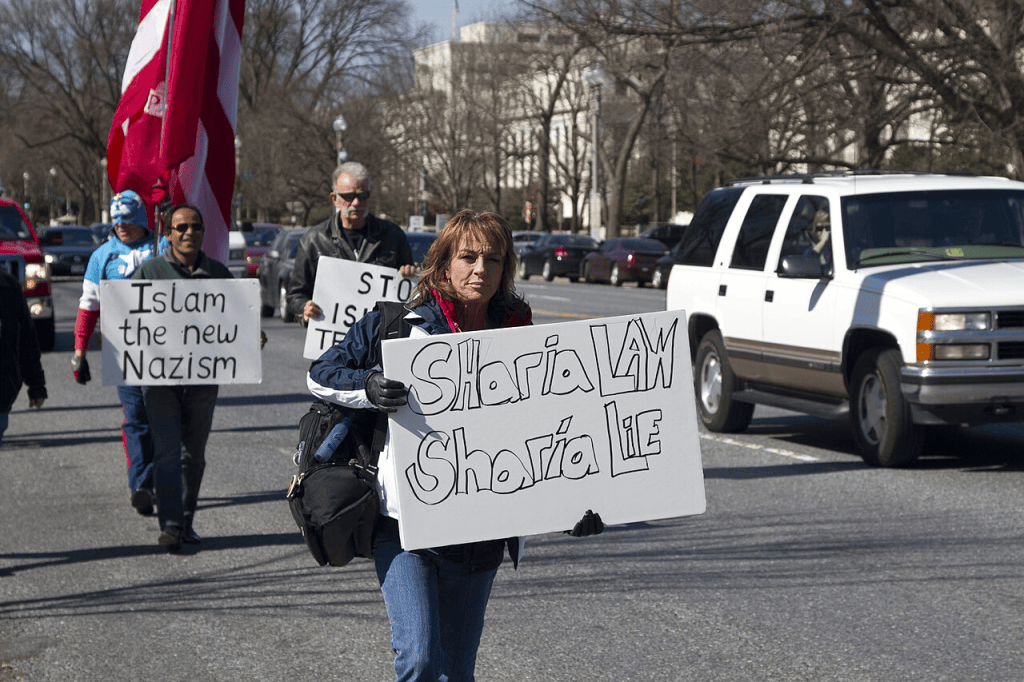
The same ministry has been tied to direct work on anti-Muslim opinion. In 2024, the New York Times and Haaretz reported, citing officials and documents, that it had paid roughly $2 million to Stoic, a political marketing firm in Tel Aviv, for an influence campaign aimed at U.S. and Canadian audiences. Meta removed more than 500 accounts, pages, and groups tied to the operation and traced them to Stoic, and OpenAI found and disrupted Stoic’s use of its tools. One network, operating as United Citizens for Canada, portrayed Canadian Muslims as a threat to Western values and circulated an altered photograph of Muslims holding a banner reading “Shariah for Canada.” The ministry called any connection to Stoic baseless. The Canadian government said it had verified parts of the campaign. Meta attributed the operation to Stoic and did not name the ministry.
In the United States, this alliance calls itself Judeo-Christian. Chip Roy invoked Judeo-Christian values when he explained why immigration policy must confront Islam, and conservative media use the phrase to describe a civilization under siege. It counts Jews as part of that civilization for as long as the Israeli state serves as its armed frontier in the Middle East.
Antisemitism is not a rhetorical device in this argument, and the figures show why. In England and Wales, in the year ending March 2025, police recorded about 106 religious hate crimes for every 10,000 Jewish residents, against 12 for every 10,000 Muslims. In Canada, Jews were the targets in 70 percent of religiously motivated hate crimes recorded in 2024, and Muslims in 17 percent. The parties Chikli invited to Jerusalem have raised the level of religious hatred in their own countries against both communities. The Israeli state claims to speak for European Jews and trades their safety for allies.
Canada shows what these arrangements are worth. In February, Mark Carney abolished both the Special Representative on Combating Islamophobia and the Special Envoy on antisemitism, weeks after the national day of remembrance for the Quebec City mosque attack, and without consulting the communities involved. Amira Elghawaby left office on February 25. The replacement council met for the first time in June at a Toronto synagogue, with antisemitism as its opening assignment. Not two years earlier, Canadians had been the target of a foreign-funded campaign telling them their Muslim neighbors wanted Shariah law.
India offers the largest case. On April 5, 2025, the President signed the Waqf (Amendment) Act into law. A waqf is a permanent Islamic endowment, and in India, waqf land holds mosques, graveyards, madrasas, and the shops whose rents support them. The new law required anyone founding a waqf to prove five years’ practice of Islam, and it gave district collectors the power to decide whether a claimed waqf property belonged to the government. In September 2025, the Supreme Court stayed provisions of the act, calling the collector’s power prima facie arbitrary. It left the abolition of waqf by use, the doctrine that recognized property as waqf through long religious use without written title, in place. Many old mosques and graveyards in India have no deeds. Their status is now open to government claims, and urban land in India is worth a great deal to the state and to the builders who work with it.
The Gulf monarchies claim to guard Islam’s holy places. They have also honored the government that passed that law. The United Arab Emirates gave Narendra Modi the Order of Zayed in 2019, and Saudi Arabia gave him its highest civilian honor in 2016. In February 2024, Modi opened a Hindu temple in Abu Dhabi on land the Emirati government donated. Millions of Indian workers labor in the Gulf under kafala, many of them Muslims from Kerala, Uttar Pradesh, and Bihar, sending wages home to families while their employers hold their passports. Gulf importers buy certified halal buffalo meat from exporters in a state that has banned the same certificate on its own shelves. No Gulf government has made the Waqf Act or the Uttar Pradesh ban a condition of its trade with India.
Hindu nationalism in New Delhi, Judeo-Christian conservatism in Texas, and republican laïcité in Paris each claim to answer the Muslim question on their own principles. The monarchs in Riyadh and Abu Dhabi, who claim to speak for Islam, trade with all of them. None of these states defends the Muslim worker.
Muslims have meanwhile entered public life in greater numbers. CAIR counted 255 Muslims holding elected office across 26 U.S. states. In November 2025, New York elected Zohran Mamdani as its mayor. The Sharia-Free America Caucus formed in Congress six weeks later, and by the summer it had 68 members from 25 states. In Canada, twenty-five years after September 11, advocates report that Muslim charities still face disproportionate scrutiny under anti-terrorism and anti-money-laundering rules. The backlash has tracked the participation.
Britain’s government has spent that period trying to define Islamophobia. Angela Rayner established a working group in February 2025 under Dominic Grieve, the former Conservative attorney general, giving it six months, keeping its advice private, and requiring that whatever it produced protect the right to insult religious beliefs. The group reported to ministers in January 2026. On March 9, the government published a non-statutory definition inside a strategy paper called Protecting What Matters, dropping the word Islamophobia for “anti-Muslim hostility” and confining it to criminal acts and harassment. Faith leaders and academics said it fell short. The Islamophobia Response Unit refused to adopt it. Thirteen months of work produced a description of conduct that was already illegal, and nothing in it reaches an employer who declines to call back a woman named Fatima, or touches the profiling practiced by Prevent.
The same government cut off state funding for Tell MAMA, which had monitored anti-Muslim incidents since 2012, in March 2025. Two months later Starmer presented an immigration white paper warning that Britain risked becoming “an island of strangers,” and his own MPs heard Enoch Powell in it. That white paper ended the social care visa, which had brought workers into the homes and wards where Britain’s older people are looked after. The Prime Minister warned about strangers and closed the route by which strangers had been arriving to feed and wash his constituents’ parents.
The remedies on offer follow the same pattern. Civil rights groups and parliamentary committees ask for name-blind job applications, transparency from the platforms, training for police and transport staff, and money for community projects. Name-blind applications hide a woman’s name until the interview, when her headscarf is visible, and questions about marriage begin. Training is offered to the same forces that prosecuted the girls Casey described and arrested four thousand people in Minneapolis. The state running Prevent and the deportation operations is asked to protect Muslims from a hostility its conduct helps produce, and it offers a definition and an advisory council.
The Somali packer at Shakopee and the man who resents her sell their labor by the hour to the same company. The Muslim women in Khattab’s unemployment figures and the white workers in the same northern towns queue at the same collapsing services. A warehouse that expects immigration agents does not strike, and a union branch that stays quiet while the mosque down the road burns will find its own members reading Reform’s leaflets within the year. Employers and landlords keep the difference, and no ministry that can dissolve its own office in an afternoon will take it back.


Leave a comment